


Executive Yuan spokesman Philip Yang (楊永明) said yesterday the government had no plan to decouple foreign workers’ wages from the minimum wage in Taiwan because such a policy would be “unfeasible.”
“From the perspective of national law and international norms, it is a complex legal and ethical issue that raises human rights concerns. The Executive Yuan has the same view as the Presidential Office on this issue,” Yang told a press conference.
“There is no point of divergence on the issue between the Presidential Office and the Executive Yuan,” he added when asked to comment on reported disagreements over the issue between President Ma Ying-jeou (馬英九) and Premier Sean Chen (陳冲).
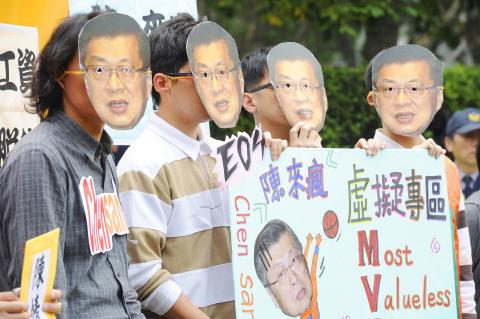
Photo: George Tsorng, Taipei Times
Local media reported that during the Chinese Nationalist Party’s (KMT) Central Standing Committee meeting on Wednesday, Ma said he supported Council of Labor Affairs Minister Jennifer Wang (王如玄) in insisting on retaining the same minimum wage system for local and foreign workers, preferring to focus on brand names and innovation as long-term strategies to enhance the country’s competitive edge rather than to engage in a race to the bottom in terms of wages.
Ma’s remarks came one day after Chen said in the legislature that the only way to adopt a two-track minimum wage system would be to establish “virtual offshore” areas to exclude the application of the minimum wage rule under the Labor Standards Act (勞動基準法) to employees in those areas.
Chen mentioned the idea again during an interview with the CtiTV on Wednesday night.
The delinking of the minimum wage for domestic and foreign workers is not allowed under the current legal system, but it was worth considering under what circumstance the wage rules for foreign workers could be considered separately of minimum wage regulations, he said.
“That’s why I proposed the idea of ‘virtual offshore’ area,” he said.
Chen said the idea of a “virtual offshore area” was an alternative to a possible free economic demonstration zone, a pilot project the government is looking to implement as it prepares the way for accession to a future Trans-Pacific Partnership trade bloc.
The proposal that would allow for free movement of capital, personnel, goods, and information is being formulated by Council of Economic and Development Minister Yiing Chii-ming (尹啟銘) and should be ready in about a year, Chen said, adding: “We will communicate with concerned parties about the issue.”
Taking issue with Chen over his remark that a “virtual offshore area” would have to be established for a dual wage system to be feasible, a labor group staged a protest outside the Executive Yuan yesterday morning.
Taiwan Labor Front secretary-general Sun Yu-lien (孫友聯) said that a dual wage system would benefit only employers. It would legitimize exploitation of migrant workers and dissuade employers from hiring local workers.
Sun said Chen’s comment was “outrageously rash” and did not offer a likely way to resolve the problem.
The minimum wage debate was triggered last week when legislators proposed the introduction of a dual minimum wage system to help protect local workers.
KMT Legislator Lo Shu-lei (羅淑蕾) said that Taiwanese companies have been forced to close or move overseas because of -increasingly higher wages for foreign workers, which in turn has cost domestic workers their jobs. The legislators suggested that the business sector be left to determine the minimum wage for foreign workers.
Additional reporting by CNA
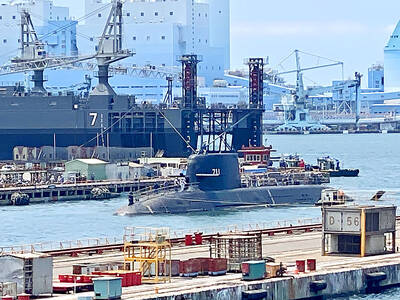
AGING: While Japan has 22 submarines, Taiwan only operates four, two of which were commissioned by the US in 1945 and 1946, and transferred to Taiwan in 1973 Taiwan would need at least 12 submarines to reach modern fleet capabilities, CSBC Corp, Taiwan chairman Chen Cheng-hung (陳政宏) said in an interview broadcast on Friday, citing a US assessment. CSBC is testing the nation’s first indigenous defense submarine, the Hai Kun (海鯤, Narwhal), which is scheduled to be delivered to the navy next month or in July. The Hai Kun has completed torpedo-firing tests and is scheduled to undergo overnight sea trials, Chen said on an SET TV military affairs program. Taiwan would require at least 12 submarines to establish a modern submarine force after assessing the nation’s operational environment and defense

A white king snake that frightened passengers and caused a stir on a Taipei MRT train on Friday evening has been claimed by its owner, who would be fined, Taipei Rapid Transit Corp (TRTC) said yesterday. A person on Threads posted that he thought he was lucky to find an empty row of seats on Friday after boarding a train on the Bannan (Blue) Line, only to spot a white snake with black stripes after sitting down. Startled, he jumped up, he wrote, describing the encounter as “terrifying.” “Taipei’s rat control plan: Release snakes on the metro,” one person wrote in reply, referring
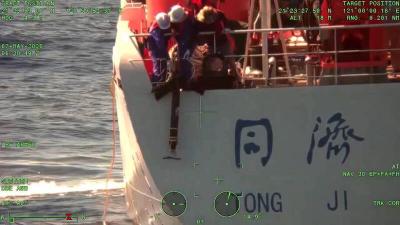
The coast guard today said that it had disrupted "illegal" operations by a Chinese research ship in waters close to the nation and driven it away, part of what Taipei sees a provocative pattern of China's stepped up maritime activities. The coast guard said that it on Thursday last week detected the Chinese ship Tongji (同濟號), which was commissioned only last year, 29 nautical miles (54km) southeast of the southern tip of Taiwan, although just outside restricted waters. The ship was observed lowering ropes into the water, suspected to be the deployment of scientific instruments for "illegal" survey operations, and the coast
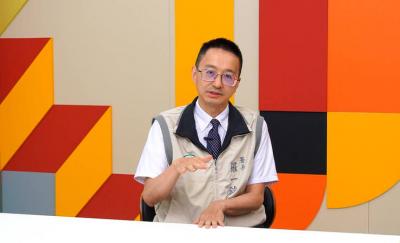
Taiwan’s two cases of hantavirus so far this year are on par with previous years’ case numbers, and the government is coordinating rat extermination work, so there should not be any outbreaks, Centers for Disease Control (CDC) Director-General Philip Lo (羅一鈞) said today in an interview with the Liberty Times (the Taipei Times’ sister newspaper). An increase in rat sightings in Taipei and New Taipei City has raised concerns about the spread of hantavirus, as rats can carry the disease. In January, a man in his 70s who lived in Taipei’s Daan District (大安) tested positive posthumously for hantavirus, Taiwan’s


 RSS
RSS